Way ~ Through Your Body!
- Home
- Foam Rolling
- Foam Roller Exercises for the Adductor Muscles
Foam Roller Exercises
for the Adductor Muscles
(Groin Muscles of the Inner Thigh)
Foam roller exercises for the adductor muscles can increase your understanding of the body-mind connection and how well you are holding it all together!
I focus on the metaphysical cause for problems with your adductors. If you continue reading about the body-mind connection for this area you may just be able to learn more about yourself and how you hold your stress!
'Look at my body. You will see the entire universe there. And all are part of the same, which is me.' ~ from The Bhagavad Gita
I would invite you to first read my overview article, called Foam Rolling for a bird's-eye view of the concept and to see a list of all my foam roller exercises for the adductor muscles and for every part of your body.
The Body Window's Self-Guided Healing Course is Now Reduced to only 19.95 USD!
Click here to learn more about how this healing course can change your life!

Foam rolling uses a practice called self-myofascial release. If you learn to do this activity in a body-mind-soul awareness fashion, you will reap many benefits.
Not only will your muscles stay stress-free, supple and elongated, but you will understand just where it is that you hold your stress, and hopefully when and why. You can show love for yourself and your body by learning these foam roller exercises for the adductor muscles!
Most sports trainers now use foam roller exercises to keep their athletes in tip-top shape. It is also used for therapeutic purposes. For you at home, if you have tight muscles from your sports activity, the self-myofascial release techniques can help you avoid seeing a doctor or therapist.
You are your own massage therapist, treating your sore muscles through foam roller exercising.
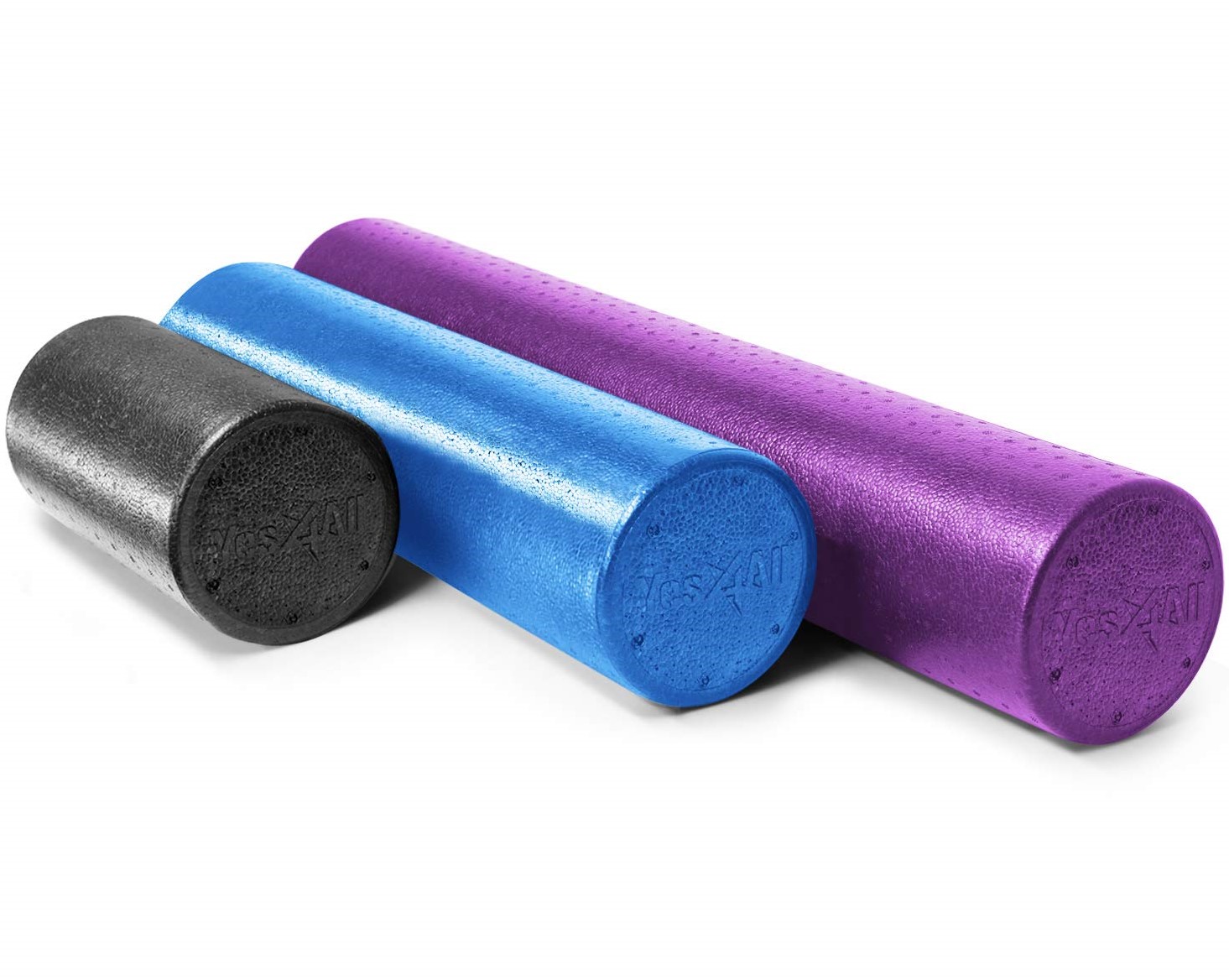
The foam rollers come in various sizes, but the most versatile one is the longest one, on the far right, in the photo, the 36" full round. All of my videos use this size and there are some of the exercises I recommend that cannot be done on another, smaller size. This is why I only recommend the 36' foam roller.
If you don't already have one, don't you think it's time to buy one now?
Since we are aware that emotions affect our body, often when you release muscular tension, emotional release follows!
As you roll and focus on your sore areas, make the whole process meditative, for the best releasing experience. This process is what I call the ability to ‘feel it and heal it.’
Moving into, instead of away from pain, helps you manage it better. Please click on the above link if you wish to understand these concepts of the body-mind connection at a deeper level, so you may heal your entire being; body, mind and soul!
The Function of the Hip Adductor Muscles
The adductor muscles of the hip are the muscles that are inside your thighs. They are well-known as the groin muscles and are easy to locate. If you are sitting, place your fingers inside your thighs just below your pubic bone and squeeze your knees together. You can immediately feel the top of the adductor muscles. As with most muscles, the adductors are actually a group of muscles, the adductor brevis, adductor longus and the adductor magnus.
The hip adductor muscles, like all muscles, have more than one action, but their main function is to bring the legs/knees together toward the center of the body. This is the exact opposite of the Tensor Fasciae Latae that abducts the leg, or pulls the leg outward away from the body.
The hip adductor muscles are also instrumental in the stability of the hip joint and are responsible for the flowing and graceful deeper movements at the hip like those done in yoga.
A lot of body-work professionals agree that the groin muscles should be included in the muscles of the core. Other experts agree that any and all muscles that connect to the torso are part of the core. They say that any muscles that attach to the pelvis or the lower back are part of the core, including all the thigh muscles and the pelvic floor muscles.
Also, any muscles that attach to the shoulder, the back or the ribs are also included in the core, namely, the muscles in the neck, the shoulder girdle, the upper arms and all the abdominal muscles. As you can see, the "core" is much, much more than what we think of traditionally, as mostly the abdominal muscles.
The engagement of the core is necessary to create the solid foundation for integrated, flowing and easy movements that are necessary in any sport to promote stability and prevent injury.
Tight groin muscles can hamper the effectiveness of your performance. Anyone who has suffered from a groin pull can attest to the importance of this muscle group in doing just about anything in the activities of daily life.
Groin pulls are most often due to insufficient conditioning and/or strengthening prior to engaging in a new sport or activity. They are more common in males, so you may extrapolate on what that might mean.
Meditate on Your Personal Meaning of Your Sore Adductor Muscles
The body metaphor for our adductor muscles, I always like to say, is surrounding the concept of "holding it all together," or "not being able to hold it all together."
Recently I have done a lot of telemark skiing, which unlike alpine skiing, you are essentially lunging down the mountain. Telemark skiing is also known as free-heel skiing. One leg is forward of the other, and the stability required in both the knees and hips is enormous as you balance yourself in the lunge position as you are flying down the mountain. Especially for an old geezer like me!
Of course, I did not do adductor muscle strengthening prior to ski season, but to my credit, I did do lots and lots of lunges. Since the body is a chain, with one muscle affecting the performance of another, the lunges did help with adductor muscle strengthening, but apparently, not enough.
During the ski season, my inner knees started killing me. I thought it was just my quadriceps or my sartorius muscles that were sore and tight from the lunging. When I finally figured it all out and went to foam roll my inner thighs, I thought I would scream in agony.
Now the vastus medialis head (one component of the quadriceps, that attaches above the knee and wraps around to the inside of the thigh) was definitely involved as well, but I don’t know why it took me so long to include the adductor muscles in my self-myofascial release program. Like the men with their groin pulls, I guess. It’s an area that goes unnoticed and un-thought-of until yours get tight and/or injured.
When I was meditating on my sore areas as I did these foam roller exercises for the adductor muscles, I couldn’t help thinking that I was not ‘holding it all together.’ Quite literally, in fact, as holding my legs together to telemark was a real issue for me – a body-mind-soul issue.
I have been seriously considering switching to alpine skiing after many, many years of telemark skiing, because the strength and effort required to telemark is no longer providing me with the enjoyment I used to get. Now it is just dang hard work. Life is too short to do an activity that no longer brings enjoyment.
It was mostly about ego-enjoyment anyway. That I was still able, as a female, over the age of 50 to telemark ski at all, was a continued accomplishment. Yet I kept finding myself switching to parallel turns (which you can actually do on telemark skis) because I would tire of lunging after about 5 runs!
My issue was related to the fact that my heart was no longer into telemark skiing and my body was letting me know that I didn’t need to hold this concept of myself any longer.
If your adductors or groin muscles are tight, meditate on what you are trying to hold together, or what you are no longer able to hold together!
Sexuality Issues of the Groin Muscles and the Inner Thigh
On a more serious note, the other issue that is intimately involved with the adductor muscles is the issue of sexuality. The movement of keeping the knees together is a sexually protective movement, especially for women, so this muscle area may hold special significance.
Holding it all together now has an entirely new meaning if you are female. Chronically held, and tensed muscles of the inner thigh may have to do with issues of abuse and other sexuality issues.
When you start foam roller exercises for the adductor muscles of your inner thighs, emotions may come out for which you are not prepared. Go slowly at first and let the feelings come. All emotions need to be expressed. If it is too frightening for you, you may wish to seek a supportive person to help you understand what it is you need to feel and release.
Since the groin muscles are connected to the pelvis and the pelvic floor, or the muscles surrounding the anus, urethra and vagina, if you have urinary issues, hemorrhoids, impotence, vaginal issues, or other sexuality issues, the inner thighs may also be affected.
If sexual abuse is in your history, I strongly urge you to seek professional help. There are many resources available to you if you do a web search for your area.
Directly opposite of holding it all together, is not being able to let go or holding it together way too tight. Hemorrhoids are usually due to constipation and constipation is the inability to let go of your feces. If you habitually tense at your adductor muscles or inner thighs because of your personal body-mind-soul issues, you may also tense your pelvic floor muscles at the same time and cause more retention.
Being unable to let go, or release the muscles of the pelvic floor and inner thighs, will cause you to push too hard to expel feces. The functions of defecation, urination and orgasm require the ability for relaxing the pelvic floor and letting go – not tensing and pushing too hard.
The hips and thighs hold lots of unreleased deep emotions, as I have discussed in Foam Rolling for the Iliopsoas, Piriformis, and Iliotibial band. Doing meditative foam roller exercises for the adductor muscles may bring forth emotions that you may not expect.
When you perform these foam roller exercises for your groin muscles or inner thighs, meditate on how these particular muscles may reflect what is going on in your life. Notice if you sense held emotions that need releasing from these tissues. Meditate on what emotions you may be trying to hold together. Meditate on what it is that you may be unable to let go.
If you so desire, you may also say positive affirmations surrounding the groin muscles and the muscles of the pelvic floor:
- I lovingly let go of all control. God/the Universe guides and supports me in all things.
- I hold loosely onto all that is important to me.
- I release all that I hold on to too tight.
- All that I no longer need in my life passes through me with ease and I give it back freely to the Universe!
- I love my body and accept it as a God-given instrument of pleasure!
- I release the past and joyfully let it go.
Or create your own positive affirmations that speak to you as your intuition guides you.
Foam Roller Exercises for the Adductor Muscles
As you practice your foam roller exercises for the adductor muscles, never forget to breathe! Sink into the "hot" spot and focus your energy there as you hold the pressure on the tight muscle for as long as you can relax and breathe. Breathe into the tension and pain. It is through holding and waiting that the muscle will eventually release.
Proceed lightly with the groin muscle if you have never worked on it before. This is a very sensitive area and may cause great pain at first. It may take some getting used to when you first start rolling here.
Pay close attention to your body and how your adductors feel when you perform these foam roller exercises. Continue to breathe deeply as you discover the knot in your muscle that needs attention. Sink into these knots. Tell your adductors that it is OK to let go, to allow the tension to release and the stress to melt away.
As you hold the pressure on the sore and tight area, and the muscle releases, you will find that so too, your emotions may release! Allow your desire to control to melt away as well. Let the feelings come. Feel them and release them, along with your tension! Feel it and heal it! Your body-mind-soul will feel the change, feel the release and become whole again.
Hip Adductor Foam Roller Exercise Video:
Written instructions to read prior to watching the accompanying video below:
- Place the foam roller parallel to the length of your body on the right side.
- Raise your upper body onto your elbows.
- Bend your right knee and put the foam roller under your knee with your leg in a bent position. I like to hook my foot on the inside of the foam roller for added stability.
- Roll up and down the inner thigh by shifting your weight from one elbow to the other.
- You can roll down towards the knee and really hit the head of the vastus medialis and sartorius as well.
- You can try this foam roller exercise standing up, placing the foam roller on a table. If you are tall, this may actually work better for you than rolling on the floor. I would recommend an 18" foam roller if you roll on a table.
- Increase the intensity of the pressure and the stretch, by sinking lower and more forcefully into the foam roller.
- Move slightly right or left to target different parts of the muscle.
- Use the video as a guide only. Move where your intuition leads you!
The following stretches can be done after the foam roller exercises for the adductor muscles. When sitting do the yoga Bound Angle Pose.
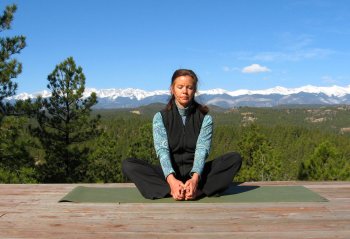
Yoginis can sit in this position with their knees touching the floor.
You can modify the position by raising your buttocks on a cushion, to the correct height to have your knees even or slightly lower than your hips. This will give you better alignment.
You can also do the yoga Wide-legged, Standing Forward Bend. This is a real nice groin stretch:

Foam roller exercises for the adductor muscles create space in your body. It helps to remind you that in order to have an open mind and an open heart to your body's messages that you must also have an open body. By stretching your body, you create the space for positive energy to flow in!
I hope that your self-discovery and your journey towards body-mind-soul healing will be enhanced by my foam roller exercises for the adductor muscles! May you always experience the healing of self-myofascial release!
Foam Roller Exercises for the Lower Body and Lower Back:
- Lower Back (Lumbar Spine).
- Hip Muscles that Focus on Opening Your Hip.
- Iliopsoas (Hip Flexors).
- Piriformis and Gluteus Muscles (Hip Muscles).
- Iliotibial Band (IT Band) and Tensor Fasciae Latae (TFL) Muscles (Side of the Thigh).
- Hamstring Muscles and Quadriceps Muscles (Thigh Muscles).
- Gastrocnemius Muscles (Calves) and Anterior Tibialis Muscles (Shins).
- Myofascial Release ~ The Self-Emptying of Body-Mind-Soul Kenosis
- Using Your Roller for Developing Intuition.
Can't find what you're looking for? Search this website:
Support This Website and Its Mission
Thank you so much for considering a donation to help support this website. I appreciate your thank-you for access to so much free information. If you feel you have been blessed by this website, thank-you for your donation! I promise, that I will continue to provide you with lots of information and pay it forward to all in whatever way I can!
© Copyright 2009-2024, by Elle Bieling, BodyWindow.com
All Rights Reserved
We also hereby confirm, as stated in our Privacy Policy, that we do not sell personal information of any kind.
Protected by Copyscape Plagiarism Checker ~ Do not copy content from this page.
Information on this website is not intended for medical advice. See your health care provider for any health concerns. By using this website and/or practicing any yoga postures, foam rolling exercises or other physical movements contained herein, you are agreeing that you are in good health, cleared by your healthcare professional to participate in physical activities and you release The Body Window from any liability involved in the practice.
This the Body Window's self-guided healing course. If you are suffering from stress, pain or dis-ease of any nature you don't want to miss this! Click here to see how this course can change your life!
Learn the Stillness Practice of Yin Yoga for the ultimate in body awareness for healing! Click here for the ebook!
Why should you have open and balanced chakras? Click Here to learn why.
Balance your Chakras in only 15 minutes/day, the Body Window way! Click Here to learn more!
All Banners and Amazon links on this website are affiliate links. As an Amazon associate The Body Window website will earn from qualifying purchases when you click on these links. I have used and love all of my product recommendations and am sure that you will too!

Do not copy content from this page.


